“Maintenance Bottlenecks” Widen U.S. Navy Readiness Gaps, Driving Reliance on Asian MRO Network to Counter China and North Korea

As one of the youngest members of the team, Tyler Hansbrough is a rising star in financial journalism. His fresh perspective and analytical approach bring a modern edge to business reporting. Whether he’s covering stock market trends or dissecting corporate earnings, his sharp insights resonate with the new generation of investors.
Authored On
Modified
U.S. Expands Naval MRO Cooperation with Asian Partners Including South Korea, Japan, and the Philippines
Overloaded U.S. Navy Maintenance System Beset by Breakdowns and Prolonged Deployments
U.S. Maritime Power Key to Asia-Pacific Security and Containing Chinese and North Korean Influence
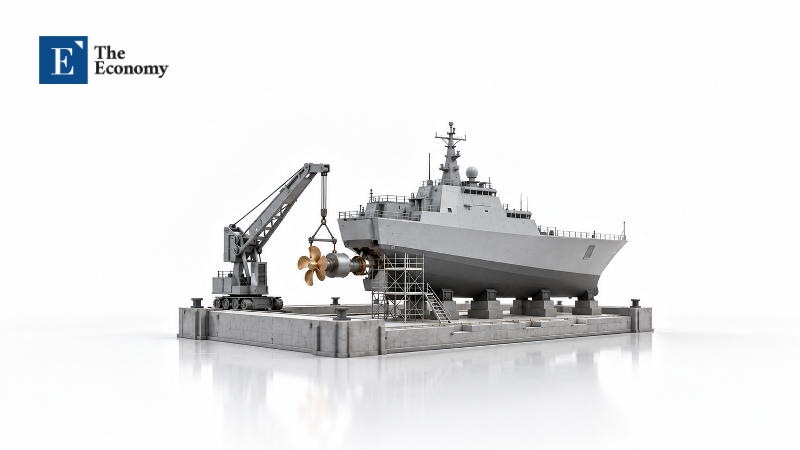
The United States is strengthening its naval maintenance, repair, and overhaul (MRO) cooperation with Asian allies. As maintenance backlogs at domestic shipyards intensify and vessel availability deteriorates, Washington is increasingly turning to regional shipbuilding and repair hubs to restore forward-deployed Indo-Pacific forces more rapidly and enhance their ability to sustain operations. This cooperative framework is expected to provide a stable foundation for maintaining U.S. naval forces tasked with countering China and North Korea, while delivering direct security benefits to regional allies.
U.S. Navy Turns to Allied Shipyards in Asia
According to a Sept. 6 report by Hong Kong’s South China Morning Post (SCMP), the U.S. Navy has recently stepped up efforts to award MRO contracts to shipyards in key Asian allies. The move is seen as an attempt to overcome the geographical distance from the U.S. mainland and maximize vessel turnaround rates in the Pacific during contingencies. Section 8680 of Title 10 of the U.S. Code generally restricts naval vessels homeported in the United States, Guam, or the Northern Mariana Islands from undergoing maintenance at foreign shipyards, but permits exceptions for voyage repairs and the restoration of damage caused by hostile action. The restrictions were further relaxed through the fiscal 2025 National Defense Authorization Act (NDAA), allowing U.S.-homeported vessels deployed overseas to receive preventive or corrective maintenance at foreign shipyards, provided the scheduled maintenance period does not exceed 21 days.
In a recent report, the U.S. think tank Center for Strategic and International Studies (CSIS) assessed that “the ability to repair and maintain more vessels quickly at forward locations as close as possible to potential conflict zones in the Indo-Pacific is crucial to sustaining long-term U.S. Navy operations, including during wartime.” With China accounting for more than half of global shipbuilding output and rapidly expanding its naval power, the strategic value of South Korea and Japan—the world’s second- and third-largest shipbuilding nations—has begun to rise alongside that of the Philippines and Singapore, which occupy geopolitical chokepoints near the South China Sea and the Strait of Malacca.
U.S. Navy Confronts Systemic Constraints
Experts caution, however, that the expansion of outsourced MRO work is not solely intended to counter China. The military overstretch and systemic breakdown confronting the U.S. Navy have also intensified the need for cooperation with allies. Data from the U.S. Government Accountability Office (GAO) and the Congressional Research Service (CRS) show that only about 11% of U.S. Navy surface ships and submarines complete maintenance at public shipyards on schedule. This reflects the Navy’s inadequate in-house MRO capacity, which has sharply increased both maintenance wait times and unplanned maintenance requirements—the periods during which vessels remain stuck in dry dock because of unexpected operational failures or aging. The number of “lost operational days” incurred while naval vessels were moored at piers exceeded 15,000 over the past decade. Meanwhile, many of the Navy’s 44 nuclear-powered attack submarines (SSNs), a core component of its asymmetric combat power, have been unable to return to sea because of growing backlogs of vessels awaiting maintenance or disposal.
These shortcomings have also caused severe disruption to actual fleet operations. According to CNN and other international media outlets, the U.S. Arleigh Burke-class destroyer USS Benfold suffered a generator-system failure on July 24 while conducting routine operations in the Indo-Pacific. CNN reported that the crew went four days without functioning cooking facilities, flush toilets, or air conditioning as daytime temperatures hovered above 32 degrees Celsius. The nuclear-powered aircraft carrier USS Abraham Lincoln, which had been deployed in the Iran war, arrived at Thailand’s Laem Chabang Port on Sept. 2 with its exterior covered in algae and signs of corrosion. U.S. defense publication TWZ described the carrier’s condition as evidence of a prolonged, high-intensity deployment, remarking that it looked as though it had “effectively been through hell.” The Lincoln had been deployed for 286 days since departing San Diego in November last year, spending much of that period engaged in combat operations against Iran in the Middle East. In effect, its crew had gone for an extended period without a meaningful opportunity to disembark and rest or conduct routine MRO work.
Cooperation Framework with Asian Partners
Under these circumstances, Asian countries with established MRO systems can serve as partners in improving the sustainability of U.S. naval power. The U.S. Navy operates its own maintenance network in Japan, with ship repair facilities and the headquarters of the Ship Repair Facility and Japan Regional Maintenance Center (SRF-JRMC) at Yokosuka Naval Base in Kanagawa Prefecture, as well as a detachment in Sasebo, Nagasaki Prefecture. Mitsubishi Heavy Industries (MHI) secured a contract to repair the U.S. Navy destroyer USS Milius in 2019 and last year won a scheduled overhaul contract for the Lewis B. Puller-class expeditionary mobile base USS Miguel Keith. Sumitomo Heavy Industries supports maintenance for key nuclear-powered aircraft carriers of the U.S. Seventh Fleet and U.S. Army landing craft, primarily from Yokosuka.
Southeast Asia and India are also emerging as major MRO hubs. Although the Philippines lacks advanced domestic shipbuilding capabilities, it has a clear geographical advantage because of its proximity to the South China Sea. U.S. private equity firm Cerberus Capital Management acquired the former Hanjin Heavy Industries-owned Aguila Subic Shipyard, while U.S. defense contractor V2X, formerly Vectrus, uses the facility as an emergency repair base for vessels damaged in the South China Sea. In Singapore, state-owned defense company ST Engineering Marine and Seatrium, which operates Asia’s deepest dry dock at 14 meters, handle maintenance for U.S. Military Sealift Command (MSC) vessels. In India, Mazagon Dock, Larsen & Toubro (L&T), and Cochin Shipyard have successively obtained MSRA certification as part of efforts to strengthen the Indo-Pacific strategy.
Table 1. Status of U.S. Navy MRO Cooperation with Major Asian Countries
| Country | Key Infrastructure and Strengths | Status of Cooperation with the U.S. Navy |
|---|---|---|
| Japan | U.S. Navy-operated maintenance network established in Yokosuka and Sasebo | Mitsubishi Heavy Industries and Sumitomo Heavy Industries support maintenance for destroyers, aircraft carriers, and expeditionary mobile base ships |
| Philippines | Strategic location of Subic Bay near the South China Sea | Aguila Subic Shipyard used as an emergency repair hub for damaged vessels |
| Singapore | Large deep-water docks and extensive commercial-vessel maintenance expertise | ST Engineering Marine and Seatrium handle maintenance for Military Sealift Command vessels |
| India | Large shipyards and access to the Indian Ocean | Mazagon Dock, Larsen & Toubro, and Cochin Shipyard obtained Master Ship Repair Agreement qualifications and joined the U.S. Navy’s maintenance network |
| South Korea | Rapid shipbuilding and repair capabilities backed by large-scale shipyard infrastructure | Hanwha Ocean has successively secured regular overhauls, mid-term availabilities, and voyage repairs for logistics support vessels, while expanding cooperation into local naval design and construction |
Hanwha Ocean Emerges as Pillar of South Korea-U.S. Cooperation
Although South Korea does not host a U.S. military-operated repair facility, its unrivaled shipbuilding and repair speed has enabled it to emerge as a core MRO partner for the United States. Hanwha Ocean has taken the lead in securing the relevant contracts. The company signed a Master Ship Repair Agreement (MSRA) with the U.S. Naval Supply Systems Command (NAVSUP) in July 2024 and secured a regular overhaul (ROH) contract the following month for the Lewis and Clark-class dry cargo and ammunition ship USNS Wally Schirra, operated by MSC. The vessel subsequently underwent approximately seven months of maintenance at Hanwha Ocean’s Geoje shipyard, covering more than 300 items, including dry-docking, hull corrosion repairs, and work on its propulsion and steering systems.
In November 2024, Hanwha Ocean also secured a scheduled maintenance contract for the 31,000-ton fleet replenishment oiler USNS Yukon, assigned to the U.S. Seventh Fleet. The Yukon underwent maintenance covering approximately 350 items at Hanwha Ocean’s Geoje shipyard during the first half of last year. In July last year, a regular overhaul contract for USNS Charles Drew—the company’s third major U.S. Navy MRO project—was formally announced. In September of the same year, Hanwha Ocean signed a mid-term availability (MTA) contract for the Wally Schirra following the vessel’s earlier large-scale overhaul. Demand for shorter-term voyage repairs has also increased this year. On Feb. 19, Hanwha Ocean secured a voyage repair contract for USNS Richard E. Byrd, followed in March by another for the expeditionary mobile base USS Miguel Keith. That same month, Hanwha Defense USA and Hanwha Philly Shipyard were selected as subcontracting partners to Vard Marine US, a global designer of naval and specialized vessels, for the U.S. Navy’s Next Generation Logistics Ship (NGLS) program, expanding the scope of cooperation into local naval design and construction.
Asia-Pacific Security Order
If this cooperative framework is sustained over the long term, the Asian countries supporting the United States are expected to reap security benefits. The U.S. Navy has long played a central role in containing the expansion of Chinese military influence in waters surrounding Asia. The Taiwan Strait is one of the principal areas of U.S. forward operations. U.S. Navy destroyers and other vessels have repeatedly transited the strait between Taiwan and mainland China, while the Navy has conducted numerous so-called Freedom of Navigation Operations (FONOPs) in areas of the South China Sea over which China claims jurisdiction. The United States defines these operations not as an attempt to deny the territorial claims of any particular country, but as activities intended to challenge “excessive maritime claims under international law.”
The Philippines likewise relies heavily on the United States for its security. As the China Coast Guard and maritime militia repeatedly threaten Philippine vessels through the use of water cannons, collisions, and route blockades, Washington has continued to pressure Beijing by affirming that the U.S.-Philippines Mutual Defense Treaty applies to armed attacks against Philippine armed forces and public vessels in the South China Sea. On the Korean Peninsula, U.S. naval forces serve as a core pillar of the combined South Korea-U.S. defense posture designed to deter North Korea’s nuclear and missile threats. The United States has maintained its deterrence posture against North Korea by regularly deploying aircraft carriers, Aegis destroyers, nuclear-powered submarines, and other naval assets around the Korean Peninsula and conducting joint exercises with the South Korean Navy. Since North Korea began advancing its nuclear and missile capabilities, U.S. carrier strike groups in particular have been employed as a prominent instrument of extended deterrence.
As one of the youngest members of the team, Tyler Hansbrough is a rising star in financial journalism. His fresh perspective and analytical approach bring a modern edge to business reporting. Whether he’s covering stock market trends or dissecting corporate earnings, his sharp insights resonate with the new generation of investors.
Similar Post