“Choking Off Tehran’s Funding”: US and EU Tighten Economic Blockade on Iran, but Regime Collapse Far From Assured Despite Mounting Civilian Hardship

Aoife Brennan is a contributing writer for The Economy, with a focus on education, youth, and societal change. Based in Limerick, she holds a degree in political communication from Queen’s University Belfast. Aoife’s work draws connections between cultural narratives and public discourse in Europe and Asia.
Authored On
Modified
EU Backs US-Led Economic Sanctions Campaign Against Iran
Sweeping US Sanctions Push Iranian Economy to Breaking Point
Pessimism Persists: “Economic Pressure Alone Unlikely to Topple Regime”
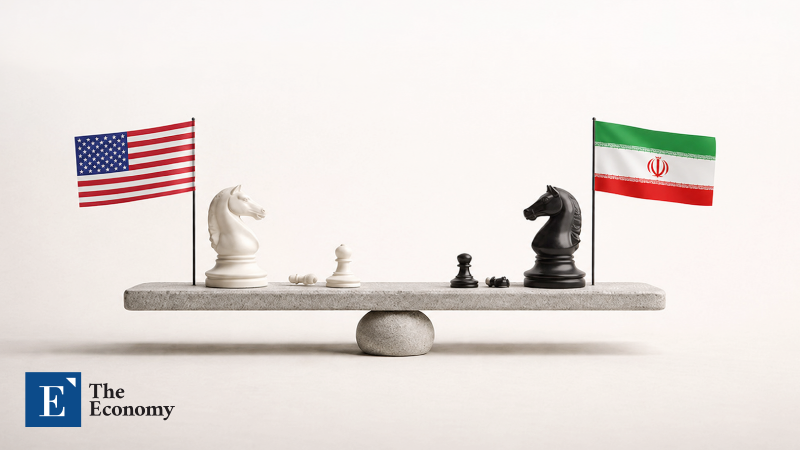
The European Union (EU) has thrown its support behind the US-led economic sanctions campaign against Iran. As Washington actively seeks to isolate Tehran economically by cutting it off from global financial and trade networks, the EU’s participation is adding further strain to the Iranian economy. Some observers caution, however, that given the ability of long-standing authoritarian regimes such as North Korea and Russia to withstand Western pressure, economic sanctions alone are unlikely to compel Iran to change course.
The EU’s Policy Toward Iran
On the 4th (all dates local time), Euronews reported that the EU had recently voiced official support for the US economic pressure campaign against Iran. In a statement issued on the 31st of last month on the occasion of a meeting of Group of 20 (G20) finance ministers and central bank governors, the European External Action Service (EEAS) said it welcomed “efforts to impose further economic pressure on Iran, including the US-led Operation Economic Exile.” The EEAS also explained that the EU had consistently called on Iran to scale back its nuclear program, limit its ballistic missile program, cease destabilizing activities in the Middle East and Europe, and end its military support for Russia’s war in Ukraine. It added that the bloc had already imposed extensive sanctions aimed at restricting Iran’s access to the international economic and financial system. The EU is reportedly prepared to take additional measures if necessary to protect its security and interests, including freedom of navigation through the Strait of Hormuz.
The United States interpreted the EU’s position as formal participation in its sanctions campaign. According to CNBC on the 3rd, US Treasury Secretary Scott Bessent recently issued a statement welcoming the EU’s decision to join Operation Economic Exile, which seeks to expel Iran completely from the international financial system. He also made clear that the pressure would continue until every source of funding for the Iranian regime had been severed. Iran strongly protested the coordinated measures by major Western powers. Iranian Foreign Ministry spokesperson Esmail Baghaei openly condemned the move, saying the EU had “succumbed to US coercion, abandoned international norms and joined in ‘economic terrorism.’”
US Launches Across-the-Board Economic Pressure Campaign
President Donald Trump has already shifted the center of gravity of the Iran war from military operations to an economic blockade. With the protracted military conflict failing to deliver the core objectives of forcing Iran to abandon its nuclear program and restoring normal navigation through the Strait of Hormuz, the administration has pivoted toward cutting off Tehran’s funding at its source. In a Truth Social post on the 19th of last month, President Trump said he would launch “the most devastating economic operation ever undertaken against any country,” describing it as “economic warfare and isolation on an unprecedented scale.” He also warned that third countries providing Iran with financial, commercial or logistical “lifelines” would pay a heavy economic price.
President Trump’s warning translated into concrete sanctions five days later. On the 24th of last month, the US Treasury Department formally announced the launch of Operation Economic Exile against Iran. In step with the announcement, the Treasury Department’s Office of Foreign Assets Control (OFAC) added five sectors—digital assets, technology, gold, aviation and shipping—to the financial, oil and petrochemical industries already subject to sanctions. The measure allows the United States to impose secondary sanctions on individuals and companies from third countries that trade with Iran or provide related services in those sectors. Around 60 companies, individuals and vessels involved in Iran’s procurement of nuclear and ballistic missile technology, cyber operations and crude oil exports were also added to the sanctions list. The measures targeted oil transportation and bunkering companies based in Singapore, Hong Kong and the United Arab Emirates (UAE), as well as vessels in the so-called “shadow fleet” used to transport Iranian crude.
Table 1. Expansion of US Sanctions Against Iran
| Target Sector or Region | Key Measures |
|---|---|
| Iranian industries | Broad sanctions on the financial, oil, petrochemical, digital asset, technology, gold, aviation and shipping sectors, with secondary sanctions also applied to third-country individuals and companies supporting related transactions |
| Crude oil transportation network | Transportation and bunkering companies based in Singapore, Hong Kong and the UAE, as well as shadow-fleet vessels carrying Iranian crude, added to the sanctions list |
| United Arab Emirates | Proposed cutoff of Bank Misr’s UAE branches from correspondent banking relationships with US financial institutions and sanctions on an official at Bank Melli’s Dubai branch who facilitated fund transfers for Iran’s Islamic Revolutionary Guard Corps |
| Hong Kong | Sanctions on a trading company that facilitated money laundering for a sanctioned Iranian currency exchange |
| Türkiye | US assets of a bank and its subsidiaries that facilitated transactions and international payments for the Islamic Revolutionary Guard Corps’ Quds Force frozen and transactions prohibited |
Sanctions Extended to Third Countries
The United States has also imposed sweeping sanctions on third-country financial institutions on several occasions. On the 28th of last month, the US Treasury Department’s Financial Crimes Enforcement Network (FinCEN) proposed a rule that would prevent the UAE branches of Egypt’s state-owned Bank Misr from accessing correspondent banking networks operated by US financial institutions. The measure was prompted by allegations that the branches had processed $1.8 billion in transactions for 103 companies suspected of links to Iran’s informal financial networks between January 2024 and June this year. On the same day, OFAC added Reza Mohammad Taedi, manager of the Dubai branch of Iran’s state-owned Bank Melli, and Hong Kong-based Kameng Trading to its sanctions list. OFAC said Taedi had acted on behalf of Bank Melli, which facilitated fund transfers for Iran’s Islamic Revolutionary Guard Corps (IRGC), while Kameng Trading had supported money laundering for an Iranian currency exchange already under sanctions.
The United States subsequently disclosed plans to make pressure on third-country financial institutions a regular feature of its sanctions campaign. In an interview with Reuters on the 30th of last month, Secretary Bessent said, “Beginning with the banking sector, we intend to announce new secondary sanctions against Iran every week.” He added, “We will call on G20 finance ministers and central bank governors to sever their economic ties with Iran and make clear that failure to comply could expose them to secondary sanctions.” Türkiye’s financial sector was designated as the latest sanctions target on the 4th. The US Treasury Department alleged that Türkiye-based Golden Global Yatırım Bankası and its subsidiaries had processed transactions worth tens of millions of dollars for the Islamic Revolutionary Guard Corps’ Quds Force (IRGC-QF) and provided Iran with access to international correspondent banking networks. Consequently, all US-based assets belonging to Golden Global and its subsidiaries were frozen, while transactions involving US persons or the US financial system were prohibited in principle.
Iran’s Economy and Livelihoods on the Brink
The US measures have dealt a “devastating blow” to an Iranian economy already under severe strain before the war. Reuters reported on the 3rd, citing three senior Iranian officials, that US economic pressure had intensified to a level increasingly difficult for the Iranian government to withstand. Successive US financial sanctions have driven up the operating costs of the smuggling networks Iran has long relied on, including front companies and unregistered insurance arrangements. As a result, intermediaries have either withdrawn from transactions or demanded higher fees, sharply reducing overall activity. According to commodity analytics firm Kpler, Iranian crude shipments stood at around 260,000 barrels per day at the beginning of this month, an approximately 85% plunge from 1.7 million barrels per day a year earlier.
Instability in prices and the currency has become even more severe. The rial, which traded at around 1 million to the dollar a year ago, has recently plunged beyond 2.2 million to the dollar, while the official average inflation rate over the past 12 months has soared to 69.9%. Price increases for food, beverages and tobacco, in particular, have approached twice the overall average. The strain on households has also reached extreme levels. The average Iranian worker earns just $125 per month, while the monthly expenditure required to cover basic household needs has climbed to around $450. The unemployment rate rose to 9.1% in the spring, while the number of employed people fell by approximately 450,000 from a year earlier. Ali Ansari, a professor at the University of St Andrews in the United Kingdom, said, “Iran is under extreme economic pressure and is also losing control over the Strait of Hormuz. Ultimately, it will have no choice but to negotiate.” Reuters also reported that “concern is mounting among Iran’s leadership that residents may no longer tolerate the economic hardship and could stage mass anti-government protests similar to those seen earlier this year.”
Authoritarian Regimes’ Strategy of Endurance
Some observers nevertheless argue that the latest US sanctions alone are unlikely to force Iran to change its position. In an article titled “Why America’s Economic D-Day Against Iran May Fail” on the 2nd, The Wall Street Journal (WSJ) observed that “authoritarian regimes have withstood Western economic pressure for years, and sometimes decades, through violence, economic adaptation and political repression.” North Korea is a prominent example. Western countries have imposed some of the world’s most stringent sanctions on North Korea for decades in an effort to curb its nuclear weapons and long-range missile threats, yet the country has endured the pressure by developing a range of survival mechanisms. More recently, it has pursued an increasingly aggressive survival strategy, dispatching troops to Russia in return for compensation and mobilizing elite cyber units to steal billions of dollars in cryptocurrency.
Russia presents a similar case. Although Russia has faced sweeping Western sanctions since its invasion of Ukraine in 2022, it has preserved President Vladimir Putin’s grip on power by redirecting trade toward non-Western countries such as China. Cuba has likewise maintained its leadership’s hold on power despite more than six decades of US embargoes and severe economic hardship. Referring to these precedents, a diplomatic affairs expert said, “Greater economic pain does not necessarily compel an authoritarian regime to change its policies or relinquish power.” The expert added, “Sanctions can instead lose much of their effectiveness if a regime tightens domestic control and secures alternative trade routes and informal financial networks.” The expert further noted, “Iran may likewise retain considerable capacity to withstand US pressure for an extended period if it can preserve its crude oil trade and financial and logistics cooperation with China and other non-Western countries.”
Aoife Brennan is a contributing writer for The Economy, with a focus on education, youth, and societal change. Based in Limerick, she holds a degree in political communication from Queen’s University Belfast. Aoife’s work draws connections between cultural narratives and public discourse in Europe and Asia.
- Previous “Crop Failures in the U.S. and Europe, Compounded by War” — Surging Global Agricultural Commodity Prices Raise Fears of a ‘Lagged Shock’ to Consumer Inflation
- Next “Inflation Keeps Wallets Shut” Japanese Household Spending Contracts for Eighth Straight Month, as Tax Cuts Raise Revenue and Fiscal Risks
Similar Post