China Injects 70 Trillion Won into State-Owned Financial Firms, but Weak Household Borrowing and Corporate Lending Bias Blunt Stimulus Impact

Siobhán Delaney is a Dublin-based writer for The Economy, focusing on culture, education, and international affairs. With a background in media and communication from University College Dublin, she contributes to cross-regional coverage and translation-based commentary. Her work emphasizes clarity and balance, especially in contexts shaped by cultural difference and policy translation.
Authored On
Modified
ICBC, Agricultural Bank of China, and insurers among eight firms to raise $50.2 billion in capital
Expanded bank lending capacity aimed at reviving investment and consumption
Weak household borrowing and concentration of corporate lending constrain spillover to domestic demand
The Chinese government is set to issue $41.8 billion in special sovereign bonds to recapitalize eight state-owned financial institutions. The plan is intended to shore up the financial soundness of a sector whose profitability has deteriorated under the strain of low interest rates and a protracted property-market slump, while expanding banks’ lending capacity to revive investment and consumption. Yet with the housing downturn having frozen household demand for credit, additional lending is likely to flow first to the corporate sector. Although the measure could ease funding strains on privately owned small and medium-sized enterprises, concerns persist that its impact on employment and consumption will be limited if credit is concentrated among state-owned enterprises and capital-intensive high-tech industries. The stock of nonperforming loans accumulated across the financial sector could also impede an expansion in new lending.
Exceptional Special-Bond Issuance Channels Capital Into State-Owned Banks and Insurers
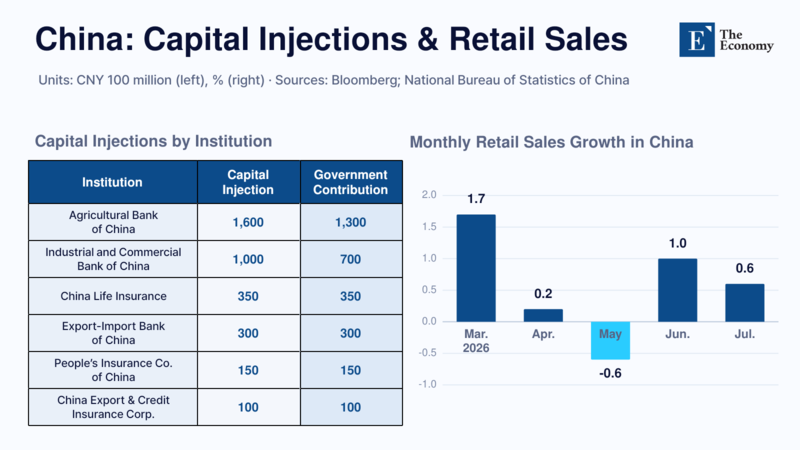
According to the state-run Xinhua News Agency on Sept. 7, China’s Ministry of Finance said that day it would issue $41.8 billion in special sovereign bonds to recapitalize eight centrally administered state-owned financial institutions. Eight firms—including major state-owned lenders Agricultural Bank of China and Industrial and Commercial Bank of China, as well as China Life Insurance, the country’s largest life insurer—had each announced plans the previous day to raise capital through mechanisms including private placements. The capital increases they disclosed total $50.2 billion, including the Ministry of Finance’s $41.8 billion contribution.
By institution, the capital increases comprise △$22.3 billion for Agricultural Bank of China △$13.9 billion for Industrial and Commercial Bank of China △$4.9 billion for China Life Insurance △$4.2 billion for the Export-Import Bank of China △$2.1 billion for the People’s Insurance Company of China △$1.4 billion for China Export & Credit Insurance Corporation △$975 million for China Taiping Insurance △$418 million for China Reinsurance.
Capital Injection Eases Low-Rate Profitability Pressure and Expands Lending Capacity to Spur Investment and Consumption
Such a large-scale direct capital injection by the Ministry of Finance into financial institutions is highly unusual, and its stated purpose is to safeguard their financial soundness. Their profitability has come under pressure as low interest rates have persisted amid prolonged weakness in consumption and the property market. Chinese commercial banks’ net interest margin (NIM) stood at just 1.41% in the second quarter, while that of the large state-owned banks fell to 1.31%. In effect, fiscal resources are being used to shoulder the burden on banks that have been required to expand policy-directed financing even as low-rate policies and lending-rate cuts erode their earnings base.
However, given that the institutions do not face an immediate deterioration in financial condition or a sharp increase in risk, many analysts view the measure as primarily aimed at stimulating consumption and domestic demand. The argument is that recapitalizing financial institutions will strengthen capital adequacy, expand their capacity to lend and invest, and ultimately increase support for the real economy. Indeed, one potential benefit of the measure is an easing of the deflationary pressure that has accumulated over an extended period. If banks use the additional capital to expand credit, reviving corporate investment and hiring, the resulting recovery in household income and consumption could generate upward pressure on prices. Expectations that prices will continue to fall have prompted consumers to delay purchases of durable goods such as automobiles and home appliances, while encouraging companies to reduce inventories and postpone investment. If moderate inflation takes hold, consumers may bring purchases forward, while improvements in companies’ nominal revenue and profits could ease the real burden of debt repayment.
Property Slump Triggers China’s Deflationary Vicious Cycle
These expectations are rooted in the vicious cycle of falling prices that has become entrenched since the property-market downturn. China’s consumer price index (CPI) recorded zero growth last year, while the producer price index (PPI) fell 2.6%. Producer prices had declined for 41 consecutive months through February this year. The gross domestic product (GDP) deflator also remained negative for 12 straight quarters through the first quarter. Weak home prices diminished the wealth effect for households, while manufacturing overcapacity intensified ruinous competition among producers. A cycle in which declining corporate profitability weighs on wages and employment, in turn further eroding consumers’ spending capacity, has become entrenched.
Although the prolonged deflationary pressure has recently eased somewhat, the absence of a recovery in domestic demand leaves the durability of the price rebound uncertain. The GDP deflator rose 1.6% year over year in the second quarter, turning positive for the first time in three years, while the CPI and PPI increased 0.5% and 3.5%, respectively, in July. Yet detailed components continue to show weak consumer demand. The CPI fell 0.1% month over month in July, while the PPI for consumer goods was 0.8% lower than a year earlier. Housing costs and automobile prices were also reported to have fallen 0.3% and 1.3%, respectively. Fitch Ratings warned that because recent price increases have been concentrated in the energy and information and communications technology (ICT) sectors, deflationary pressure could intensify again without a clear recovery in domestic demand.
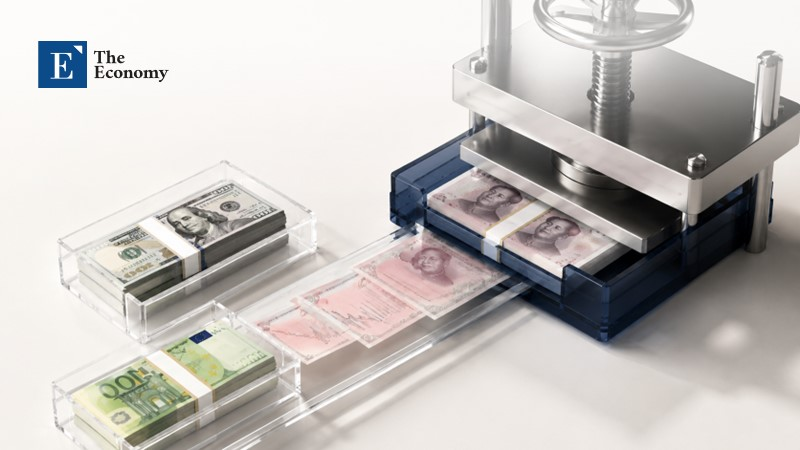
Chinese Households Shun New Debt Despite Monetary Easing
For the capital injected into financial institutions to alleviate deflation, it must translate into increased new lending to households and businesses. For now, however, banks’ additional credit capacity is more likely to be absorbed first by the corporate sector. Proceeds from the special sovereign bonds will initially be booked as capital by financial institutions, strengthening their loss-absorption capacity and financial soundness while giving banks room to expand their loan assets without compromising capital ratios. The money will begin flowing into the real economy only after banks use this newly created capacity to extend loans to businesses and households.
Of the $50.2 billion total capital increase, $40.4 billion will be allocated to Agricultural Bank of China, Industrial and Commercial Bank of China, and the Export-Import Bank of China to support an expansion in lending. These funds will provide a foundation for commercial banks to increase new credit and for policy banks to broaden industrial support. The $9.8 billion allocated to five insurers is primarily intended to strengthen financial soundness and bolster their capacity for medium- and long-term investment. The near-term impact on the real economy is therefore also likely to emerge first through increased lending by the three banks.
Yet households remain reluctant to take out new loans despite persistently low interest rates. Reuters calculations based on People’s Bank of China data showed that new bank lending contracted by $47.4 billion in July, the largest decline since records began. Household loans fell by $64.1 billion, more than three times the $18.1 billion decline in corporate loans.
The protracted housing-market slump was the largest factor behind the contraction in household lending. According to Reuters, prices of new homes in China fell 0.1% month over month and 3.2% year over year in July. Of the 70 cities surveyed, home prices rose from the previous month in only 17. As home prices continue to decline and transactions remain sluggish, households have correspondingly less incentive to borrow to purchase homes.
Funding Relief for Cash-Strapped SMEs
Policy has also tilted toward corporate finance. In January, the People’s Bank of China (PBOC) established a $139.3 billion relending facility to support privately owned small and medium-sized enterprises. Outstanding relending reached $111.5 billion at the end of July, while the balance of related loans stood at $2.1 trillion at the end of the second quarter, benefiting approximately 2.5 million businesses. The weighted-average interest rate on new loans in the first half was also 0.4 percentage points lower than a year earlier. The combination of relending targeted at local financial institutions and capital injections into large state-owned banks has broadened the policy foundation for channeling funds to private enterprises.
If loans are disbursed in a timely manner, cash-strapped companies could gain immediate breathing room. For businesses that have secured orders but cannot pay wages or suppliers because of delays in collecting accounts receivable, access to working capital can mark the starting point for normalizing operations. It remains uncertain, however, whether an increase in outstanding loans will translate directly into an industrial recovery and employment growth. China’s state-owned banks have historically concentrated lending on state-owned enterprises and strategic industries with low credit risk and an expectation of government support. Privately owned SMEs lacking sufficient collateral could remain at a disadvantage in loan screening despite accounting for a large share of employment.
Surging Demand for AI and Semiconductor Funding, but Employment Impact Uncertain
Moreover, advanced manufacturing sectors such as semiconductors, artificial intelligence (AI), and robotics require substantial capital expenditure and research and development investment, making it difficult to assume that job creation will rise in proportion to the funds committed. A Reuters analysis of corporate filings and data from financial information provider LSEG found that around 50 AI, semiconductor, and robotics companies had applied to list on mainland Chinese exchanges by mid-June this year. Their proposed offerings totaled at least $17.6 billion. The large pipeline of companies awaiting listings demonstrates that growth companies are actively seeking long-term capital for research and development and capital investment.
Nonperforming loans accumulated across the financial sector also constrain an expansion in corporate lending. According to British weekly The Economist, a court in China’s Anhui province approved a restructuring plan for local asset management company (AMC) Guohou Asset Management in July. It was China’s first case in which a financial company established to acquire and dispose of banks’ nonperforming loans was itself placed under restructuring, after troubled assets removed from bank balance sheets were transferred to the asset manager and subsequently impaired its own financial condition. Continued infusions of new funding into uncompetitive companies could allow low-productivity firms to remain in the market, exacerbating overcapacity and ruinous competition.
Siobhán Delaney is a Dublin-based writer for The Economy, focusing on culture, education, and international affairs. With a background in media and communication from University College Dublin, she contributes to cross-regional coverage and translation-based commentary. Her work emphasizes clarity and balance, especially in contexts shaped by cultural difference and policy translation.
Similar Post