Weak Yen Explains Why Japanese Outbound Travel Is Dwindling

Working across research, policy, and data-driven analysis, the Editorial Board ensures that published pieces reflect a consistent institutional perspective grounded in quantitative reasoning and long-term structural assessment.
Authored On
Modified
Weak yen is suppressing Japanese outbound travel
Stronger purchasing power historically increased overseas travel
Lower passport fees cannot offset stagnant household incomes
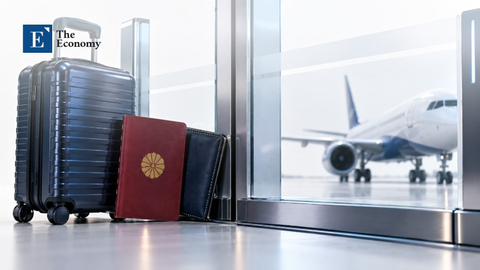
In 2025, Japan welcomed 42.7 million visitors, a record number up 33.9 percent from 2019 levels. In the same year, only 14.7 million Japanese traveled abroad, while only 18.5 percent of the Japanese population had a valid passport, lower than the 24 percent recorded in 2019. This gap does not arise from a lack of interest. It is very often attributed to cultural characteristics, as if the Japanese prefer to stay home because their own country already has what they need. The data show something much more concrete. Japanese travelers do not miss airports because they do not want to leave, but because their income is no longer enough to do so, a reality that the country's own history belies.
Record Inbound Tourism, Stagnant Japanese Outbound Travel
Peter Chai, a researcher at Waseda University's Faculty of Political Science and Economics, describes the phenomenon as a one-way internationalization. Inbound visitors and international students are growing rapidly, while the outbound mobility of the Japanese themselves remains limited. At the end of 2025, Japanese citizens held 22.82 million valid passports, a percentage that increased slightly from 17.3 percent a year ago but remained well below pre-pandemic levels. At the same time, the country hosted a record 408,069 international students by May 1, 2025, while just 91,054 students from Japanese higher education institutions went abroad in fiscal year 2024, with two-thirds of these experiences lasting less than a month.
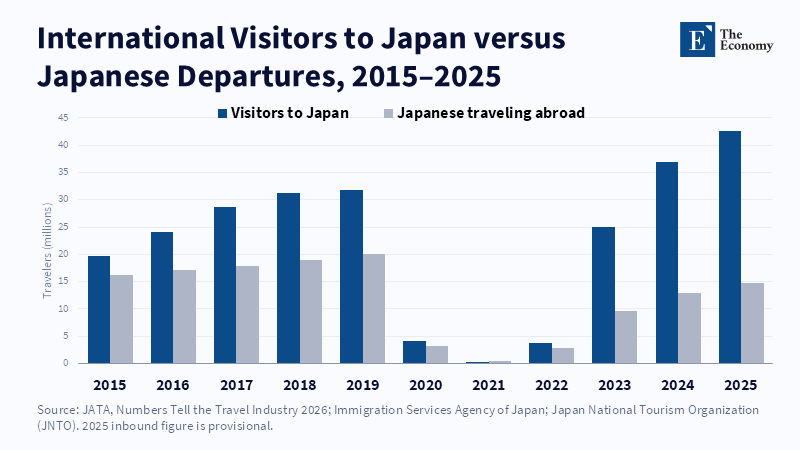
This asymmetry is not only reflected in official statistics. The Japanese government has set a goal of increasing outgoing pupils and students to 500,000 by 2033, but the target for international students in Japan, which was 400,000, had already been exceeded by 2025. Government policy internalises, without explicitly admitting it, that the country's extroversion is moving at two speeds. Institutions are opening the door inward faster than they manage to push their own citizens out and the cost of this imbalance is not only symbolic.
A Strong Yen Once Transformed Japanese Travel
The narrative of an introverted Japanese character struggles to explain what happened in the decades before today's stagnation. In 1964, when Japan liberalized overseas travel, just 128,000 citizens traveled abroad. The number exceeded 5 million in 1986, reached 10 million in 1990 and rose to 18.49 million in 2012 and a record 20.08 million in 2019, according to data from the Japan Tourism Organization. This acceleration did not come about by chance. It followed the Plaza Agreement in 1985, when the five major economies agreed to devalue the dollar, causing the yen to almost double its value in two years, from about 240 to 120 per dollar.
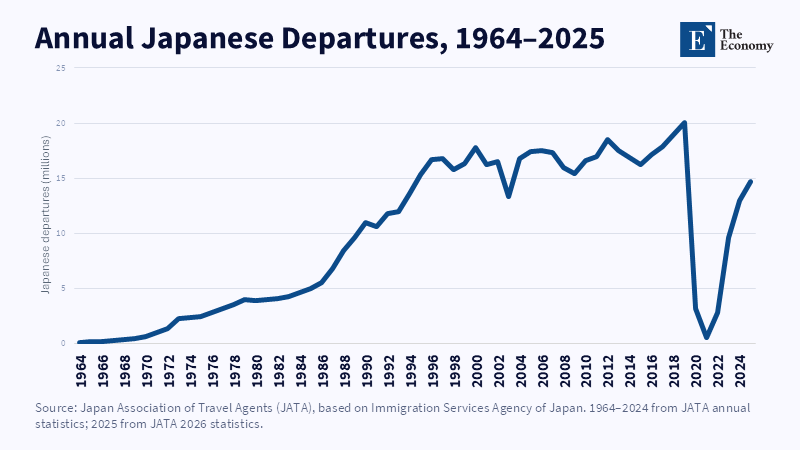
This strength of the currency turned foreign travel from a privilege of the few to an affordable habit for millions of Japanese households. The United States was the most popular destination, while France dominated Europe. The same pattern was later repeated with China, where rising incomes and a stronger currency led to a similar explosion of outbound tourism, economists at Natixis noted. This comparison reveals the true mechanism behind the mobility of a country's citizens. It is not a cultural preference that changes from generation to generation, but a function of purchasing power. When the currency strengthens and incomes rise, citizens travel. When the opposite happens, mobility declines, no matter how attractive the rest of the world remains.
The Weak Yen Is Pushing Travel Costs Beyond Wages
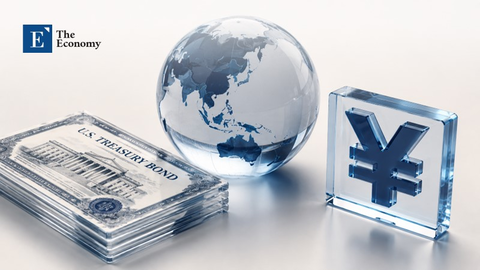
The yen is now the opposite of the 1980s. It fell to 162 per dollar at the end of June and close to 164 at the end of July, with its real weighted exchange rate remaining close to the lowest levels since the early 1970s. Behind this weakness is a prolonged stagnation in productivity. According to the Japan Productivity Center, the country's hourly labor productivity stood at $60.10 in purchasing power parity terms in 2024, ranking Japan 28th among the 38 OECD countries, while productivity per employee placed it last among the Group of Seven countries.
This stagnation has an impact on wages. According to OECD data, the average salary of a Japanese worker in terms of purchasing power parity amounted to 51,461 in 1991 and $51,129 in 2022, while the OECD average increased by 32.5 percent. On this basis of income, a Japanese household is now required to cover the cost of a trip abroad, which, according to a JTB survey, amounted to an average of $2,098 last year, up 6.2 percent from the previous year, as air tickets, accommodation costs and foreign exchange costs increased at the same time.
The result is a consumption category where prices rise faster than incomes. In the same JTB survey, 78.9 percent of respondents said they are not planning to travel abroad. Among the reasons, high costs garnered 33.6 percent of responses, inadequacy of family finances 26.4 percent and weakness of the yen 24.4 percent. These three causes are, in essence, the same cause expressed in three different words. It is a lack of disposable income.
Cheaper Passports Cannot Solve Japan’s Income Problem
On July 1, 2026, the Japanese government drastically reduced the cost of issuing a passport, from 15,900 yen to 8,900 yen for adults, with the aim of reviving outbound mobility. But the measure addresses only a small fraction of the real obstacle. The cost of issuing a passport corresponds to less than 3 percent of the average cost of a trip abroad. Matthew Reuter, economics editor at The Economy, notes that lower fees alone are not enough to convince citizens to travel when the underlying problem remains their purchasing power.
An alternative explanation, quite widespread, attributes the retreat to a younger generation that has turned inward, less curious about the outside world than their parents and grandparents. The data do not confirm this position. Research cited in the East Asia Forum article shows that the outbound travel rate among women aged twenty to twenty-nine reached 29.4 percent in 2024, almost three times the general rate of 10.5 percent of the population, while younger respondents appeared less likely to consider a stronger yen a prerequisite in order to travel to a destination that attracts them. A Reiwa Travel survey of 4,127 people aged eighteen to twenty-nine found high levels of anxiety about cost, language and health and safety among those with no previous experience traveling abroad, suggesting a lack of familiarity rather than a conscious rejection.
This explanation has a second, less obvious dimension. The prolonged decline in outbound tourism has interrupted the transfer of experience from parents to children. When parents do not travel, children grow up without the familiarity that would make a trip abroad less daunting. The phenomenon feeds itself, not because the character of a generation changes, but because the experience gap widens as long as the economic squeeze lasts.
Japan’s Outbound Mobility Gap Extends Beyond Tourism
The decline in outbound mobility is not just about holidays. Japanese companies are now drawing on a narrower pool of workers capable of operating in multiple languages, markets and institutional cultures, while the country's own educational institutions are hosting record numbers of international students without Japanese students themselves gaining similar experience abroad. At the same time, the foreign resident population in Japan has risen to a record 4.1 million amid demographic shrinkage and labor shortages, while this has coincided with increasingly contentious public debate over immigration, a trend reflected in opinion polls.
The International Monetary Fund predicts that Japan's gross public debt will reach 203 percent of GDP this year, with interest spending expected to nearly double from 1.5 percent of GDP by 2031. Prime Minister Sanae Takaichi has announced a plan to mobilize more than $2.32 trillion in public and private investment by fiscal year 2040, but without productivity growth, fiscal expansion risks putting additional pressure on government bond yields and the currency itself. Measures such as greater financial support for long-term study abroad, flexible academic calendars and a review of rigid graduate recruitment programs that penalize those who are absent for a long time would approach the problem from the right side, that of cost rather than intention.
The narrative of a country so complete that its citizens do not need the rest of the world remains convenient because it does not require any reform. The figures paint a different picture. The 42.7 million visitors who arrived in Japan last year and the only 14.7 million Japanese who went abroad do not reflect two different mindsets, but two sides of the same exchange rate. The 1980s proved that when income and currency allow, Japanese travelers fill the airports as much as any other people. The question that remains open is not whether the Japanese want to see the world, but when their income will allow them to do so again.
This article reflects the analytical judgment of The Economy Editorial Board and does not constitute policy advice or the official position of any affiliated institution.
References
Benoza, K. (2023) ‘Why Japan has so many “never travelers”’, CNN, 19 February.
Chai, P. (2026) ‘Japan’s global exposure has a one-way ticket’, East Asia Forum, 31 August.
International Monetary Fund (2026) Japan: 2026 Article IV Consultation. IMF Country Report No. 26/075. Washington, DC: IMF.
Japan Association of Travel Agents (2024) ‘Trends in the number of overseas travellers’, Travel Statistics. Tokyo: JATA.
Japan National Tourism Organization (2026) Visitor Arrivals for December 2025. Tokyo: JNTO.
Japan Productivity Center (2025) International Comparison of Labor Productivity 2025. Tokyo: Japan Productivity Center.
Japan Student Services Organization (2026) Results of the 2024 Survey of Japanese Students Studying Abroad and the 2025 International Student Survey. Tokyo: JASSO.
JTB Corp. (2025) 2025 Travel Trend Outlook. Tokyo: JTB.
Ministry of Foreign Affairs of Japan (2026) Passport Statistics for 2025. Tokyo: MOFA.
Organisation for Economic Co-operation and Development (2026) Average Annual Wages. Paris: OECD.
Reuter, M. (2026) ‘“Overseas Travel Is a Luxury”: 80% of Japanese Lack Passports as Three Decades of Stagnation Entrench Travel Aversion’, The Economy, 11 August.
Working across research, policy, and data-driven analysis, the Editorial Board ensures that published pieces reflect a consistent institutional perspective grounded in quantitative reasoning and long-term structural assessment.