Migration and Economic Growth: Why Skills and Location Matter

Working across research, policy, and data-driven analysis, the Editorial Board ensures that published pieces reflect a consistent institutional perspective grounded in quantitative reasoning and long-term structural assessment.
Authored On
Modified
Migration supports growth when skills complement domestic workers
Urban settlement can amplify migrant innovation and productivity
Policy outcomes depend on selection, integration and geography

For the first time in more than half a century, Brookings estimates suggest that U.S. net migration turned negative in 2025, following a sharp tightening of immigration policy. Early estimates by Brookings Institution economists Wendy Edelberg, Stan Veuger and Tara Watson link the shift to a slowdown in growth of close to 0.2 percentage points that year, mainly through a smaller labour force. Something similar had already happened once. The quota laws of 1921 and 1924 closed a door that had remained open for forty years, after more than twenty million people entered the country. The comparison of the two moments brings back the same question on both sides of the Atlantic. A larger workforce does raise the growth rate, or the outcome depends largely on who ultimately crosses the border.
Migration and Economic Growth: Labour Supply and Productivity
The basic logic is simple and difficult to challenge at the theoretical level. More workers mean a greater potential output, especially in economies where the birth rate is declining and the working-age population is shrinking. A larger and more heterogeneous working population not only adds hands, but also skills that the existing labour market did not already have, which can raise productivity beyond mere numerical summation.
This relationship is not only theoretical. In an analysis prepared for the International Monetary Fund, it was calculated that an increase in migration inflow by one percentage point in total employment raises output by almost 1 percent by the fifth year, through the combination of skills that complement each other rather than overlap. The finding concerns advanced economies and not the migration of refugees to emerging markets, where barriers to integration into the local labour market remain significant and the positive effect is not equally true. This differentiation is crucial because it shows that the relationship between migration and growth is not stable regardless of circumstances. It depends on how easily newcomers are integrated into the production process, which directly refers to the question of who is actually entering the country.
The labour supply argument gains particular weight in ageing populations, where the number of retirees is growing faster than the number of those entering the labour market. In Germany, Italy and Greece, where the fertility rate has remained consistently below the population reproduction threshold for decades, the migration influx acts as the only short-term labour force replacement mechanism that does not require a change in births, which react much more slowly to any political intervention. The potential output of an economy depends largely on the size of the available labour force, so a larger pool of workers opens up, at least in terms of potential growth rate, a wider margin than an economy with a stagnant or declining population. How much of this potential margin is converted into real productivity again depends on the composition of the input.
Mass Immigration, Innovation and the Cost of Restriction
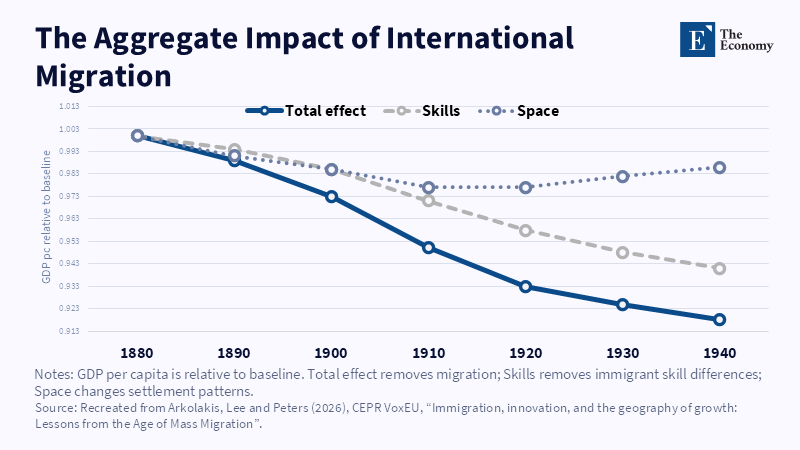
The American experience of 1880 to 1920 offers a rare natural experiment, because it combines a huge influx with an abrupt interruption. Over twenty million people arrived in that time, mostly from Southern and Eastern Europe, before the quotas of 1921 and 1924 closed the borders for an entire generation. Economists used a quantitative model to estimate what would have happened without that wave, combining the entirety of the U.S. patents of the period with individual census data and millions of original immigration records. They conclude that without Mass Immigration, U.S. GDP per capita would have been 8.2 percent lower by 1940.
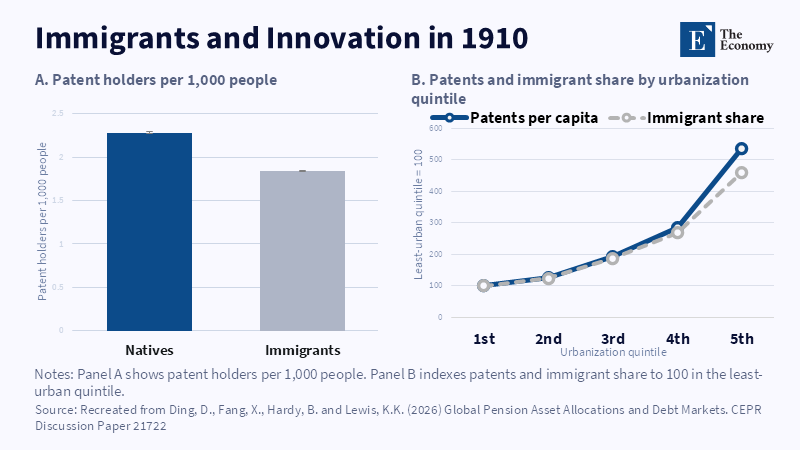
The striking element of their research is not only the magnitude of this effect, but its composition. About three-quarters of the result is attributed to the skills that immigrants brought, especially their contribution to innovation; immigrants accounted for nearly one-fifth of all inventors in the country at the time. Where immigrants settled also mattered substantially, as their concentration in urban innovation centers such as New York, Chicago and Philadelphia multiplied their contributions through proximity to ideas and expertise.
When the researchers looked at the reverse scenario, i.e. what would have happened if quotas had been lifted between 1930 and 1960, the result was much more limited. Per capita output by 2000 would have been only 1.7 percent higher, a fraction of the original effect, partly because the U.S. population had now multiplied and partly because the groups excluded from quotas were, on average, less skilled than natives. The conclusion is not that immigration does not matter, but that marginal population addition has a different value depending on its composition and the size of the existing base on which it is added.
Who Migrates Today: Selection and Skills
This is where the objection is often raised when comparing the Ellis Island era with today, that the background and work ethic of those who arrived then have nothing to do with the composition of today's migration flows. This hypothesis, however, is not easily confirmed by historical evidence. Ran Abramitzky and Leah Boustan, in an extensive review of immigrant selection in American history, show that during the Era of Mass Migration, the selection of arrivals was mixed; some nationalities were positively selected in terms of skills relative to the population of the country of origin, others negatively, without a uniform standard. British immigrants, for example, recorded higher patent rates than natives themselves, while Italian and Irish immigrants lagged markedly behind, a difference linked to the professions they practiced before leaving their country.
The current picture is, on the contrary, more uniform towards the positive choice. According to the same researchers, today's immigrants to the U.S. are largely positively selected in terms of observable characteristics, a shift that is partly explained by the increase in U.S. income inequality, which increases the returns to skill and partly by the very design of modern admissions systems, which are based on work visas, educational criteria and family reunification chains around already settled immigrants. At the same time, the perception that the country is experiencing an unprecedented "flood" of arrivals is not confirmed by the figures. Economist Stefanie Stantcheva, along with Alberto Alesina and Armando Miano, in a survey of 24,000 respondents in six countries, recorded that Americans estimate the share of immigrants in the population to be around 36.1 percent, when the real rate is close to 14 percent, a figure that roughly corresponds to what was true for decades during the Ellis Island period. Overestimating size often fuels overestimation of composition.
Immigration and Crime: What the Evidence Shows
Beyond the issue of skills, concern about the legality and behavior of newcomers remains central to today's debate, especially when the conversation turns to irregular migration. The assumption that larger migration flows are accompanied by more crime is not confirmed, however, by the most recent available data. Researchers Alex Nowrasteh and Michelangelo Landgrave of the Cato Institute analyzed data from the 2024 American Community Survey and found that the incarceration rate of irregular immigrants was 674 per 100,000 people, lower than the corresponding rate of native-born Americans, which reached 1,195 per 100,000. Legal immigrants recorded the lowest rate of all groups, at 303 per 100,000. The finding is not isolated; it is part of a series of investigations spanning from 2017 to the present day and consistently comes to the same conclusion: that the risk of deportation acts as a strong disincentive for the irregular migrant group in particular.
This is not to say that there are no real policy issues around migration, from the ability of asylum systems to manage the volume of applications to the adequacy of integration resources in housing, language and the labour market. However, shifting the debate to generalized assumptions about criminality distracts attention from the variables that actually determine the economic outcome of an immigration policy, namely who is accepted, by what criteria it is chosen and where it is ultimately settled. For policymakers on both sides of the Atlantic, the practical consequence is that law enforcement resources pay off more when they are directed at specific risks than when they broadly target an entire population based on their migration status.
Immigration Policy Beyond Numbers
The European experience shows that the shift towards skills criteria has already begun at the institutional level, even if the public debate remains focused on absolute numbers of arrivals. The revised European Union Blue Card and the EU Talent Pool established in 2026 are explicitly aimed at a skilled workforce, implicitly recognising the same conclusion reached by the U.S. experience of the last century, that the composition of arrivals largely determines the economic benefit. These tools do not replace the debate on numbers, but complement it with a criterion that the net count of arrivals systematically omits.
The comparison between 1921 and 2025 does not lead to a simple conclusion for or against immigration as such. It shows, on the contrary, that the hypothesis behind many of today's concerns, namely that today's immigrants are inherently less suitable than those of an idealized previous generation, does not stand on the facts that actually exist. The choice was not lost, it simply changed form, from mixed and random to more systematically positive, while the crime rate of immigrant groups remains, based on the most recent record, lower and not higher than that of the native population.
The question that remains open is different and it concerns what the current shift towards more restrictive policies will actually cost. If the logic of the 1930s holds true again, the cost may turn out to be less than the initial picture of 8.2 percent suggests, precisely because the current American economy is based on a much larger base than that of 1920. Whether this is also true in the European case, where demographic shrinkage is steeper and the base is smaller, remains a question that today's data have not yet answered with the same clarity that the 1940 data finally offered.
This article reflects the analytical judgment of The Economy Editorial Board and does not constitute policy advice or the official position of any affiliated institution.
References
Abramitzky, R. and Boustan, L. (2017) ‘Immigration in American economic history’, Journal of Economic Literature, 55(4), pp. 1311–1345.
Alesina, A., Miano, A. and Stantcheva, S. (2023) ‘Immigration and redistribution’, Review of Economic Studies, 90(1), pp. 1–39.
Arkolakis, C., Lee, S.K. and Peters, M. (2026a) ‘Immigration, innovation, and the geography of growth’, NBER Working Paper 35392. Cambridge, MA: National Bureau of Economic Research.
Arkolakis, C., Lee, S.K. and Peters, M. (2026b) ‘Immigration, innovation, and the geography of growth: Lessons from the Age of Mass Migration’, VoxEU, 8 September.
Edelberg, W., Veuger, S. and Watson, T. (2026) ‘Macroeconomic implications of immigration flows in 2025 and 2026: January 2026 update’, Brookings Institution, 13 January.
Engler, P., MacDonald, M., Piazza, R. and Sher, G. (2023) ‘The macroeconomic effects of large immigration waves’, IMF Working Paper 2023/259. Washington, DC: International Monetary Fund.
European Parliament and Council of the European Union (2021) Directive (EU) 2021/1883 on the conditions of entry and residence of third-country nationals for the purpose of highly qualified employment. Official Journal of the European Union, L382.
European Parliament and Council of the European Union (2026) Regulation (EU) 2026/1047 establishing an EU Talent Pool. Official Journal of the European Union, 12 May.
Eurostat (2026) Demography of Europe: 2026 edition. Luxembourg: Publications Office of the European Union.
Nowrasteh, A. and Landgrave, M. (2026) ‘Illegal immigrant incarceration rates, 2010–2024: The demographics of American imprisonment’, Cato Briefing Paper No. 198. Washington, DC: Cato Institute.
Working across research, policy, and data-driven analysis, the Editorial Board ensures that published pieces reflect a consistent institutional perspective grounded in quantitative reasoning and long-term structural assessment.