“Stop Russian Airstrikes” — Europe Moves to Send More Patriot Missiles to Ukraine, but Depleted U.S. Stockpiles and Ukraine’s Defense-Budget Waste Hobble Effort

Oliver Griffin is a policy and tech reporter at The Economy, focusing on the intersection of artificial intelligence, government regulation, and macroeconomic strategy. Based in Dublin, Oliver has reported extensively on European Union policy shifts and their ripple effects across global markets. Prior to joining The Economy, he covered technology policy for an international think tank, producing research cited by major institutions, including the OECD and IMF. Oliver studied political economy at Trinity College Dublin and later completed a master’s in data journalism at Columbia University. His reporting blends field interviews with rigorous statistical analysis, offering readers a nuanced understanding of how policy decisions shape industries and everyday lives. Beyond his newsroom work, Oliver contributes op-eds on ethics in AI and has been a guest commentator on BBC World and CNBC Europe.
Authored On
Modified
Europe seeks to supply Ukraine with Patriot missiles through PURL
Ukraine, battered by Russian offensives, also appeals to South Korea and Japan for support
U.S. Patriot stocks plunge amid Iran war, while corruption in Ukraine’s defense sector compounds shortfall
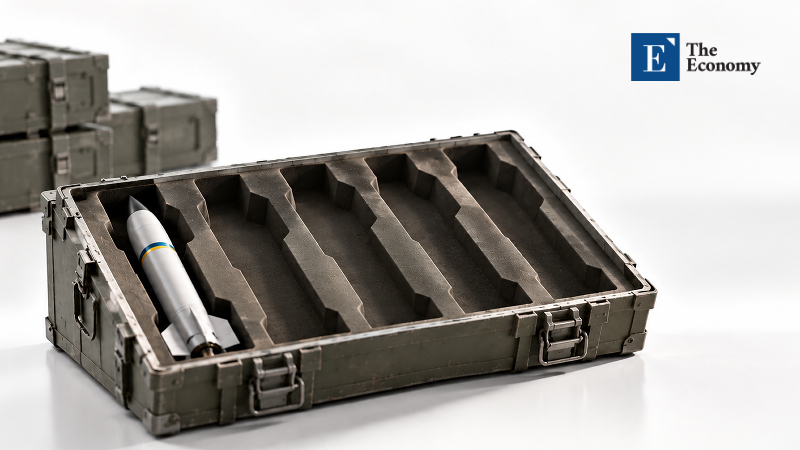
European countries are moving to purchase additional U.S.-made Patriot interceptor missiles for delivery to Ukraine. The initiative comes as Russia intensifies large-scale airstrikes combining drones with ballistic and cruise missiles, widening Ukraine’s air-defense missile supply gap. However, expectations are mounting across the international community that Ukraine will struggle to secure sufficient missile supplies in the near term. The United States has expended a substantial share of its Patriot inventory during the war with Iran, while corruption and waste in Ukraine’s defense procurement system have further aggravated the problem.
Europe Renews Support for Ukraine
According to Bloomberg on the 8th (local time), European countries are finalizing plans to use contributions to the Prioritized Ukraine Requirements List (PURL) to purchase a new package of Patriot interceptor missiles from the United States. PURL is a procurement mechanism under which the United States supplies American-made weapons and ammunition to Ukraine, with NATO allies and partner countries covering the cost. Ukraine’s Ministry of Defense said that, as of July, 29 countries had joined PURL and contributed a combined $6.7 billion, funding more than 10 weapons packages. It added that approximately 95% of the Patriot interceptors delivered to Ukraine, including PAC-3 missiles, are supplied through PURL. The United Kingdom has already pledged an additional $135 million to PURL, part of which will be used to purchase Patriot interceptors. Germany, Greece and the Czech Republic are also considered likely participants in the latest air-defense support initiative.
European governments are also pursuing plans to draw directly from their own military missile stockpiles. At the 36th meeting of the Ukraine Defense Contact Group (UDCG), also known as the Ramstein Group, on the 8th, Germany announced that it would “urgently supply Ukraine with PAC-2 Patriot interceptor missiles held by the Bundeswehr.” German Defense Minister Boris Pistorius urged other donor countries to reassess their own air-defense missile inventories and provide additional support to Ukraine. Around the informal meeting of foreign ministers held in Wicklow, Ireland, on the 1st and 2nd of this month, the European Commission likewise pressed southern European countries, including Spain and Greece, to provide Ukraine with part of their Patriot interceptor inventories.
South Korea and Japan Balk at Requests for Support
Ukraine has also stepped up appeals for assistance from countries outside Europe. In June, for example, Ukrainian Foreign Minister Andrii Sybiha met South Korean Foreign Minister Cho Hyun in Seoul and stressed the need for air-defense weapons. Oleksandr Kamyshin, strategic adviser to the Ukrainian president, visited South Korea in early July and met officials from the Ministry of National Defense and the Defense Acquisition Program Administration, requesting support in the form of PAC-3 missiles, the latest Patriot interceptors operated by the South Korean military. In an interview last month, Ukrainian President Volodymyr Zelensky directly appealed for assistance, saying, “We desperately hope that South Korea will support us with air-defense systems.” South Korea’s Foreign Ministry responded that “the provision of South Korean defense materiel has been conducted in accordance with domestic law,” adding that it would “continue to consider support in nonmilitary areas, including energy, infrastructure, health and education.” The remarks were interpreted as a reaffirmation of Seoul’s existing policy against directly supplying lethal weapons.
Ukraine made an even more direct request to Japan. In an interview with Kyodo News last month, Ukrainian Prime Minister Serhii Koretskyi said, “Patriot-family interceptors are urgently needed to protect our people and power infrastructure and to endure the coming winter heating season,” adding, “We have strong expectations for Japan’s support.” The Japanese government, however, effectively rejected the request. At a regular press conference later that month, Chief Cabinet Secretary Minoru Kihara said that transferring to Ukraine equipment classified as “weapons” under Japan’s Self-Defense Forces Act and intended to kill or destroy was “not under consideration at this time.” Japan revised its Three Principles on Transfer of Defense Equipment and Technology and related implementation guidelines in April to broaden the scope of exports of weapons with lethal capabilities, but direct exports to countries at war remain prohibited in principle.
Russia Escalates Airstrikes
Ukraine’s urgent appeals come as Russian airstrikes have intensified markedly this summer. Russia has stepped up combined saturation attacks, first deploying large numbers of low-cost drones to disperse and deplete Ukraine’s air defenses and then concentrating ballistic and hypersonic missile strikes. A notable example came overnight on the 4th and 5th of last month, when Russia launched 28 missiles, including 24 ballistic missiles, and 115 drones at Ukraine. Ukrainian forces shot down 98 drones but failed to intercept a single missile, and at least 17 people were killed in Kyiv and surrounding areas.
The offensive continued into late August. On the 20th of last month, Russia launched a large-scale attack combining ballistic and cruise missiles with drones against the Kyiv area, killing at least 16 people and injuring more than 40. Residential buildings, schools, hospitals and fuel facilities were also damaged. Zelensky said that Russia deployed approximately 2,000 attack drones, more than 1,600 glide bombs and 31 Russian- and North Korean-made missiles across Ukraine in the week from the 22nd to the 29th of last month alone. In another attack on the 1st of this month, Russia simultaneously launched 218 unmanned aerial vehicles, Iskander-M, S-400 and KN-23-series ballistic missiles, and Zircon and Kalibr cruise missiles. Ukrainian forces intercepted 187 drones and some of the cruise and ballistic missiles, but strikes hit 28 locations, including Kyiv and Odesa, killing at least 12 people.
Interceptor Supply Gap Widens
The problem is that deliveries of interceptor missiles to Ukraine have declined even as Russia’s launch volume has increased. Zelensky said on the 5th of last month that “the volume of air-defense missiles received from allies in the first half of this year fell to one-third of the level recorded in the same period last year.” The decline is widely seen as a consequence of the prolonged U.S.-Iran war. Earlier this month, the Associated Press, citing U.S. defense officials and a NATO official, reported that Patriot interceptor inventories held by U.S. forces stationed in Europe had fallen below critical levels. The United States transferred part of its European Patriot stockpile to the Middle East and expended large numbers of interceptors defending against Iranian ballistic missile and drone attacks. The Center for Strategic and International Studies (CSIS) estimates that the United States used approximately 65%, or about 1,500, of its roughly 2,330 Patriot interceptors during the Iran war.
Production growth has also failed to keep pace with rising demand. Lockheed Martin, which manufactures the Patriot PAC-3 Missile Segment Enhancement (MSE), has annual production capacity of only about 600 missiles. In January, the U.S. government and Lockheed Martin developed a plan to raise annual capacity to 2,000 missiles, but that target is not expected to be reached until late 2030. Europe’s indigenous production system has yet to come fully online. According to NATO, Europe’s first Patriot missile production facility is scheduled to begin operations in Germany this September, but actual deliveries are unlikely to begin before early next year. Moreover, initial output is likely to be allocated first to countries with existing orders, including Germany, the Netherlands, Romania and Spain.
Table 1. Constraints on Interceptor Missile Supplies to Ukraine
| Constraint | Key Details |
|---|---|
| Shortage of U.S. stockpiles | Sharp decline in Patriot inventories following transfers to the Middle East and increased interception of Iranian missiles and drones |
| Production and expansion limits | Production capacity below demand and a lengthy timeline for achieving large-scale output increases |
| European supply constraints | Europe’s first indigenous Patriot production facility set to begin operations, with initial output expected to be prioritized for countries with existing orders |
Gaps in Ukraine’s Defense Procurement System
Compounding the shortage is entrenched corruption in Ukraine’s defense procurement system. An analysis by The New York Times of records obtained from Ukraine’s State Audit Service and internal Defense Ministry audits found that Ukraine incurred $1.2 billion in losses in 2024 alone because of fraud, overpayments and contract defaults in the weapons procurement process. Auditors found that 18 companies that had previously failed to fulfill contracts properly were awarded new government contracts, including six that had not successfully completed a single previous contract. Seven of the Ukrainian Defense Ministry’s 10 largest military suppliers also received new contracts despite records that included fraud investigations, failure to honor existing contracts and arrests of executives on corruption charges.
Procurement failures translated into reduced battlefield supplies, not merely accounting losses. According to the audit records, Ukraine lost $126 million in 2024 by paying unnecessarily high prices, including through a contract with a Czech intermediary for rockets worth hundreds of millions of dollars despite a manufacturer offering a lower price. The New York Times noted that as overpayments and nondeliveries accumulate, the volume of ammunition and weapons obtainable under the same budget inevitably falls. Tamerlan Vahabov, a former adviser to Ukraine’s Defense Procurement Agency, likewise explained that “when nondelivery and overpayment erode the budget, the result is ultimately less money to order additional weapons and a shortage of the ammunition that is needed.”
Oliver Griffin is a policy and tech reporter at The Economy, focusing on the intersection of artificial intelligence, government regulation, and macroeconomic strategy. Based in Dublin, Oliver has reported extensively on European Union policy shifts and their ripple effects across global markets. Prior to joining The Economy, he covered technology policy for an international think tank, producing research cited by major institutions, including the OECD and IMF. Oliver studied political economy at Trinity College Dublin and later completed a master’s in data journalism at Columbia University. His reporting blends field interviews with rigorous statistical analysis, offering readers a nuanced understanding of how policy decisions shape industries and everyday lives. Beyond his newsroom work, Oliver contributes op-eds on ethics in AI and has been a guest commentator on BBC World and CNBC Europe.
Similar Post